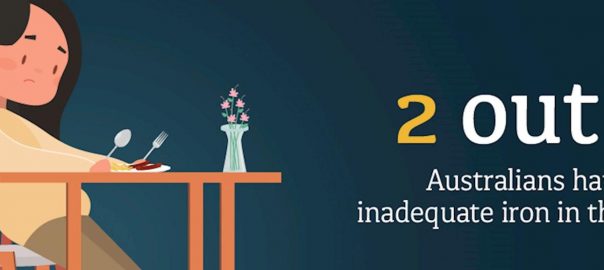
People often hear the terms “iron deficiency” or “anaemia”, but what do these terms mean and why is it important? Some research studies have quoted up to 20% of the Australian female population having iron deficiency.
1 For women post-pregnancy, this proportion is even higher and can be cause for a number of symptoms. But how do you know if you are “iron deficient”? Then, most importantly, if you
are iron deficient, what can you do about it?
We asked Dr Natasha Feingold, an experienced GP who frequently treats iron deficiency at the Bourke Street Clinic, to answer a few questions about this condition and find out what the buzz is all about.
“Iron deficiency is EXTREMELY common. We see it in General Practice everyday and it’s something that can have a significant impact on your life,” says Dr Feingold. “There is a difference between iron deficiency and anaemia: iron deficiency means you don’t have enough iron in your system, which is what’s needed to make healthy red blood cells. Anaemia is when you don’t have enough red blood cells, but it can be caused by all kinds of things, not just iron deficiency.”
Symptoms of iron deficiency include:
– Lethargy
– Headaches
– Dizziness
– Shortness of breath
– Chest pain
– Pale skin
– Palpitations
– Brittle nails
– Painful, inflamed tongue
Research studies suggest that two out of five Australians are having an inadequate amount of iron in their diet
2.
“If you have any of the symptoms mentioned, it’s important to have a fasting blood test to check what your haemoglobin and iron levels are,” says Dr Feingold. “If you are iron deficient, it’s also important to investigate what is causing the iron deficiency.”
Being deficient in iron means one (or more) of these three things:
- You are not taking in enough iron in your diet
- You aren’t absorbing iron properly
- You are losing too much iron through blood loss (eg menstruation, GI bleeding)
Dr Feingold has a word of warning, “When I discover that someone is iron deficient, it is of utmost importance to me that each possibility is investigated. I think a lot of patients are just told to go on some iron supplements without properly identifying the actual cause.”
Figuring out why someone is iron deficient includes things like reviewing one’s diet, doing more blood tests (and sometimes stool tests), and sometimes having a camera look inside the gastrointestinal tract. The practitioners at Bourke Street Clinic are well-versed in following up patients who are found to be iron deficient and/or anaemic.
“While we are investigating the cause, it is still very important that iron deficient patients supplement their intake with either tablets or an infusion,” says Dr Feingold.
At Bourke Street Clinic, we are one of the few General Practices in Sydney who can perform our own iron infusions for our patients. Our doctors not only assess you and provide the infusion, but they also monitor you throughout the infusion to ensure your safety. The entire process takes about 30 minutes and many patients can come in on their lunch break and go straight back to work or home without it disrupting their schedule. Public hospitals also offer iron infusions, however, it can take up to half a day to get the procedure done.
“Improving your iron can have amazing effects on one’s health. We are seeing more and more research come out about better outcomes in pregnancy, heart failure, and ADHD, just to name a few conditions,” adds Dr Feingold. “Not only can it boost your energy levels but it can help prevent further complications that can make you really sick. Iron supplementation is such an easy fix, yet some patients aren’t aware that this type of treatment can be done in a general practice setting.”
If you are interested to talk more about iron deficiency and its treatment, don’t hesitate to make an appointment to talk to Dr Natasha Feingold about the process and whether you are an appropriate candidate for an iron infusion.
Reference:
1: Ahmed F, Coyne T, Dobson A, McClintock C. Iron status among Australian adults: findings of a population based study in Queensland, Australia. Asia Pac J Clin Nutr. 2008; 17(1): 40-47.
2: http://www.abs.gov.au/ausstats/abs@.nsf/Lookup/by%20Subject/4364.0.55.008~2011-12~Main%20Features~Iron~402#2



 In my experience, patients will attend our clinic at a variety of stages along their cancer journey.
There are those patients who see our doctors and other practitioners regularly for their usual health screening or disease management, and we may have detected their cancer as part of their regular healthcare process. We may have arranged the investigation of symptoms such as a lump or pain or a change of bowel habit that led to a cancer diagnosis.
Where we are involved in a patient’s care from the outset, we are able to guide them to the right specialists and integrate and interweave adjunctive therapies safely throughout their cancer-specific treatment including preparation and support throughout treatment.
In many cases, patients seek us out because they have already been diagnosed with cancer and want a plan for getting through treatment. Some patients are able to work with their general practitioner to put together an integrative plan, but unfortunately some patients encounter resistance or hostility to the suggestion of some treatments that are considered to be outside of the “mainstream”.
Then there are the patients who have been through cancer-specific treatment without integrative support and find their way to us because they are struggling with their recovery. Treatment has left them feeling fatigued, drained, depressed and depleted.
With the right information and professional guidance, you can protect yourself from some of the negative impact of cancer treatment on your physical and emotional health.
There are many lifestyle changes, activities and adjunctive or “complementary” therapies that you can apply alongside your specific cancer treatments that will make things easier for you by relieving or preventing side effects, improving the effectiveness of specific treatments or helping you to rehabilitate physically and emotionally.
EXCERPT FROM “THE CANCER RECOVERY GUIDE” by Prof Kerryn Phelps AM
In my experience, patients will attend our clinic at a variety of stages along their cancer journey.
There are those patients who see our doctors and other practitioners regularly for their usual health screening or disease management, and we may have detected their cancer as part of their regular healthcare process. We may have arranged the investigation of symptoms such as a lump or pain or a change of bowel habit that led to a cancer diagnosis.
Where we are involved in a patient’s care from the outset, we are able to guide them to the right specialists and integrate and interweave adjunctive therapies safely throughout their cancer-specific treatment including preparation and support throughout treatment.
In many cases, patients seek us out because they have already been diagnosed with cancer and want a plan for getting through treatment. Some patients are able to work with their general practitioner to put together an integrative plan, but unfortunately some patients encounter resistance or hostility to the suggestion of some treatments that are considered to be outside of the “mainstream”.
Then there are the patients who have been through cancer-specific treatment without integrative support and find their way to us because they are struggling with their recovery. Treatment has left them feeling fatigued, drained, depressed and depleted.
With the right information and professional guidance, you can protect yourself from some of the negative impact of cancer treatment on your physical and emotional health.
There are many lifestyle changes, activities and adjunctive or “complementary” therapies that you can apply alongside your specific cancer treatments that will make things easier for you by relieving or preventing side effects, improving the effectiveness of specific treatments or helping you to rehabilitate physically and emotionally.
EXCERPT FROM “THE CANCER RECOVERY GUIDE” by Prof Kerryn Phelps AM  For years, I’ve been a jogger but now my back pain is so bad I can’t run anymore. I thought I was doing the right thing by exercising and now I learn I’ve been harming myself. What are some good exercises for people with back pain who want to remain fit?
You can’t necessarily blame the jogging for your back pain. I would suggest you get an individual exercise program from a sports physiotherapist or exercise physiologist. Generally speaking though, it is essential to keep your muscles well-toned and your level of aerobic fitness up. Find types of exercise that challenge you but do not cause pain. For example walking, some swimming strokes, aquafitness, Tai Chi and yoga (the instructor will need to know you have back problems) can keep you moving. Make sure you do a series of gentle stretches before and after exercise.
Is it better to choose a chiropractor, an osteopath or a regular physiotherapist to get help for an aching back?
There is no simple answer for this question. Some people find that a particular approach or a specific health professional is able to help them with their back pain where others might find that a different approach works for them. Most people with mechanical low back pain find a combination of physical “hands on” therapy, analgesia, back exercises and back care instruction most helpful. First try to confirm the cause of your back pain.
When would a doctor recommend surgery for back problems such as a prolapsed disc? How successful is back surgery?
The majority of people (around 90%) with a prolapsed disc get better without surgery. You would need an MRI and a surgical opinion if your symptoms were still causing problems after 3 months or if there were signs of significant pressure on a nerve. Surgery involves removing the protruding part of the disc to make more room for the nerve being compressed, and it has a high rate of success in expert hands. If you have difficulty with bowel or bladder function, decreased sensation around your genitals, or progressive leg weakness, this may be an indication of a medical emergency. These days, minimally invasive surgical techniques are used where the scar is very small and recovery is expected within weeks. If you are considering surgery, talk to your surgeon at length about the technique, possible dangers and expected recovery time.
For years, I’ve been a jogger but now my back pain is so bad I can’t run anymore. I thought I was doing the right thing by exercising and now I learn I’ve been harming myself. What are some good exercises for people with back pain who want to remain fit?
You can’t necessarily blame the jogging for your back pain. I would suggest you get an individual exercise program from a sports physiotherapist or exercise physiologist. Generally speaking though, it is essential to keep your muscles well-toned and your level of aerobic fitness up. Find types of exercise that challenge you but do not cause pain. For example walking, some swimming strokes, aquafitness, Tai Chi and yoga (the instructor will need to know you have back problems) can keep you moving. Make sure you do a series of gentle stretches before and after exercise.
Is it better to choose a chiropractor, an osteopath or a regular physiotherapist to get help for an aching back?
There is no simple answer for this question. Some people find that a particular approach or a specific health professional is able to help them with their back pain where others might find that a different approach works for them. Most people with mechanical low back pain find a combination of physical “hands on” therapy, analgesia, back exercises and back care instruction most helpful. First try to confirm the cause of your back pain.
When would a doctor recommend surgery for back problems such as a prolapsed disc? How successful is back surgery?
The majority of people (around 90%) with a prolapsed disc get better without surgery. You would need an MRI and a surgical opinion if your symptoms were still causing problems after 3 months or if there were signs of significant pressure on a nerve. Surgery involves removing the protruding part of the disc to make more room for the nerve being compressed, and it has a high rate of success in expert hands. If you have difficulty with bowel or bladder function, decreased sensation around your genitals, or progressive leg weakness, this may be an indication of a medical emergency. These days, minimally invasive surgical techniques are used where the scar is very small and recovery is expected within weeks. If you are considering surgery, talk to your surgeon at length about the technique, possible dangers and expected recovery time.  Many people suffer common gut conditions without even realising it. These conditions can cause a number of symptoms that are often overlooked, like: